

Background Screening Compliance Is More Complex Than Ever
Employers today operate in an increasingly complex regulatory environment. While federal laws provide a foundation for employment background screening, states and municipalities continue to introduce additional requirements that impact how employers conduct background checks, evaluate criminal history information, and make hiring decisions.
For organizations hiring across multiple states, compliance requires more than following federal guidelines. Employers must understand how federal, state, and local regulations interact while maintaining consistent, fair, and efficient hiring practices.
The Foundation: Federal FCRA Requirements
The federal Fair Credit Reporting Act (FCRA) establishes the foundation for employment background screening compliance. It outlines requirements employers and consumer reporting agencies must follow when using background checks as part of the hiring process.
Key FCRA requirements include:
- Obtaining proper authorization before conducting a background check
- Providing required disclosures to applicants
- Following required adverse action procedures
- Ensuring reported information is accurate and up to date
- Providing applicants an opportunity to dispute potentially inaccurate information
While the FCRA creates a nationwide standard, it is only the starting point. Employers must also consider additional state and local requirements that may impose stricter obligations.
Federal Requirements vs. State Employment Laws
Many states limit when employers can inquire about criminal history, often delaying those questions until after a conditional offer of employment. Some states restrict the use of non-conviction records, expunged records, or older convictions, while others require employers to conduct individualized assessments before making an adverse employment decision.
At the same time, federal regulations establish specific requirements for individuals working in transportation and other safety-sensitive positions.
Examples include:
- Commercial drivers are subject to federal requirements related to drug and alcohol violations through the FMCSA Drug & Alcohol Clearinghouse.
- TSA regulations identify disqualifying offenses for individuals requiring security threat assessments.
- DOT-regulated employers must ensure employees in safety-sensitive positions meet all applicable federal requirements before performing covered duties.
- Certain state licensing boards maintain separate eligibility standards that may impact an individual’s ability to perform regulated work.
Failing to understand how these requirements interact can create significant compliance risks, including discrimination claims, negligent hiring concerns, and regulatory violations.
The Growing Complexity of State and Local Screening Regulations
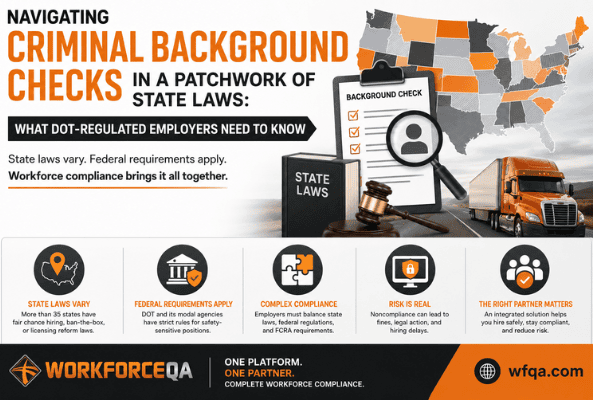
Across the country, states and municipalities have enacted laws that expand upon federal background screening requirements. These regulations may affect when employers can ask about criminal history, what information can be considered, how disclosures are provided, and what steps must be taken before making an employment decision.
One of the most common areas of regulation is fair chance hiring, often referred to as “ban-the-box” laws. These laws are designed to give applicants an opportunity to be considered for employment before criminal history information is reviewed.
For employers, this means screening programs must be flexible enough to accommodate different requirements depending on where an employee is hired or works.
For employers operating across multiple jurisdictions, managing these requirements can quickly become complicated.
A motor carrier operating throughout the 48 contiguous states, for example, may need to account for requirements such as:
California’s individualized assessment requirements and restrictions on certain criminal records.
New York’s Article 23-A requirements, which evaluate whether a conviction has a direct relationship to the position.
Pennsylvania’s direct relationship standard for employment decisions.
Illinois requirements regarding whether a conviction is substantially related to the job or presents a public safety concern.
State restrictions on the use of expunged, sealed, or non-conviction records.
“Ban-the-box” laws continue to reshape hiring practices by delaying criminal history inquiries until later in the hiring process, giving candidates an opportunity to be evaluated on their qualifications first. While employers can generally conduct background checks after a conditional offer, requirements vary by jurisdiction, with some states restricting what information may be considered and requiring individualized assessments before adverse action is taken. HR teams must stay informed to ensure compliance while balancing fair chance initiatives with workplace safety and negligent hiring considerations.
Source: Adapted from reporting by the Society for Human Resource Management (SHRM) on evolving “ban-the-box” and fair chance hiring laws
Managing these regulations manually is challenging, particularly for employers hiring hundreds or thousands of employees each year. Background screening is no longer a one-time hiring step. It is part of a broader workforce compliance strategy that continues throughout the employee lifecycle.
Background Screening Is Only One Part of Hiring Compliance
Employment compliance does not end with background screening. Employers must also manage employment eligibility verification requirements through the Form I-9 process.
Administered by U.S. Citizenship and Immigration Services (USCIS), Form I-9 verifies an employee’s identity and authorization to work in the United States. Employers must ensure forms are completed accurately and within required timelines, documents are reviewed properly, and records are maintained securely.
Some employers also use E-Verify, an electronic employment eligibility verification system that compares information from Form I-9 documents with federal records. Certain employers, industries, and government contractors may have additional obligations related to E-Verify participation.
Because background screening, drug and alcohol testing, occupational health requirements, and employment eligibility verification often occur during the same hiring process, organizations benefit from a coordinated compliance strategy that improves consistency and reduces administrative burden.
Building a Multi-State Compliant Screening Program
Managing background screening compliance across multiple jurisdictions requires ongoing attention. Employers should regularly review:
- State and local fair hiring requirements
- Criminal record reporting restrictions
- Disclosure and authorization forms
- Adverse action procedures
- Employment eligibility verification requirements
- Industry-specific regulations
A successful screening program balances consistency with flexibility. Employers need standardized processes to support efficiency while maintaining the ability to adapt to state-specific requirements.
Technology also plays an important role. A centralized compliance platform can help organizations track screening activity, manage workflows, maintain documentation, and provide visibility throughout the hiring process.
Compliance Is a Continuous Process
Background screening regulations continue to evolve, making proactive compliance essential for employers. Understanding the relationship between federal requirements and state-specific regulations helps organizations reduce risk, protect applicants, and create a fair hiring process.
With the right expertise, technology, and compliance partner, employers can confidently navigate the complexities of modern background screening.
WorkforceQA: Helping Employers Navigate Background Screening Compliance
WorkforceQA helps employers simplify the complexities of background screening compliance with comprehensive solutions designed to support federal, state, and local requirements.
With in-house background screening services, PBSA accreditation, and FCRA-certified professionals, WorkforceQA provides employers with the expertise needed to build compliant screening programs while supporting faster, more informed hiring decisions.
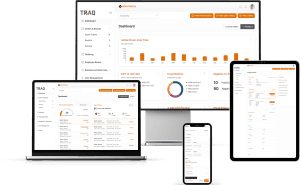
Through the TRAQ platform, employers can manage background screening, drug and alcohol testing, occupational health services, and workforce compliance activities through one secure platform.
WorkforceQA’s background screening solutions include:
- National, state, and county criminal searches
- Employment and education verifications
- Motor Vehicle Record (MVR) searches
- Customized screening packages
- FCRA-compliant adverse action support
- Real-time status tracking and reporting
- Secure workflow management through TRAQ
Backed by more than 30 years of industry experience and trusted by thousands of employers nationwide, WorkforceQA helps organizations navigate changing regulations while maintaining an efficient and compliant hiring process.
One Platform. One Partner. Complete Workforce Compliance.
Ready to simplify background screening compliance? Contact WorkforceQA to learn how our FCRA-compliant screening solutions and TRAQ platform can help your organization manage hiring compliance across all 50 states.