

The EEOC’s recent decision marks a shift in federal enforcement priorities, but employers still have important responsibilities when using criminal history in hiring decisions.
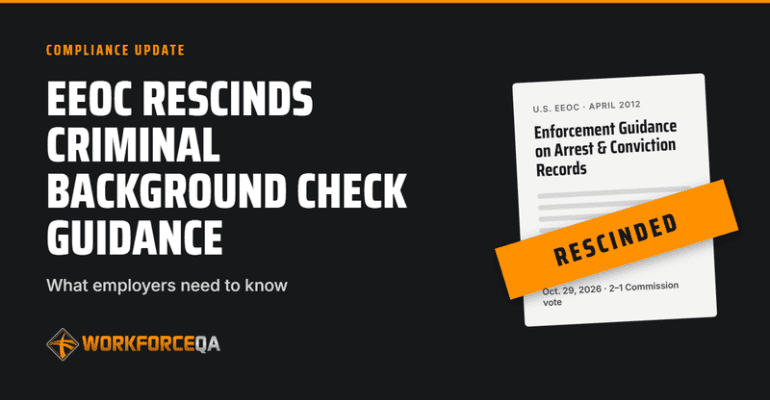
Employers that use criminal background checks as part of their hiring process have a new development to consider. On October 29, 2026, the U.S. Equal Employment Opportunity Commission (EEOC) announced that it had rescinded its 2012 enforcement guidance on the use of arrest and conviction records in employment decisions.
The decision, effective immediately, represents a change in the agency’s approach to federal discrimination enforcement. However, it does not eliminate employers’ legal obligations or give organizations unrestricted permission to use criminal history when evaluating applicants.
For employers, the takeaway is straightforward: background screening policies still need to be thoughtful, consistent, and compliant with applicable laws.
What Changed?
The EEOC’s 2012 guidance addressed how an employer’s use of criminal history could raise Title VII concerns under the Civil Rights Act of 1964.
The guidance focused on two forms of discrimination:
- Disparate treatment: Occurs when applicants are treated differently because of a protected characteristic. For example, rejecting one applicant based on a particular conviction while allowing another applicant with the same conviction to move forward could raise discrimination concerns.
- Disparate impact: Occurs when a seemingly neutral employment policy disproportionately affects members of a protected group. A blanket policy excluding anyone with a criminal record, for example, could disproportionately screen out applicants from certain racial or national origin groups.
The 2012 guidance encouraged employers to consider whether criminal screening policies were job-related and consistent with business necessity. It also recommended evaluating criminal records individually rather than automatically disqualifying applicants based on the existence of a record.
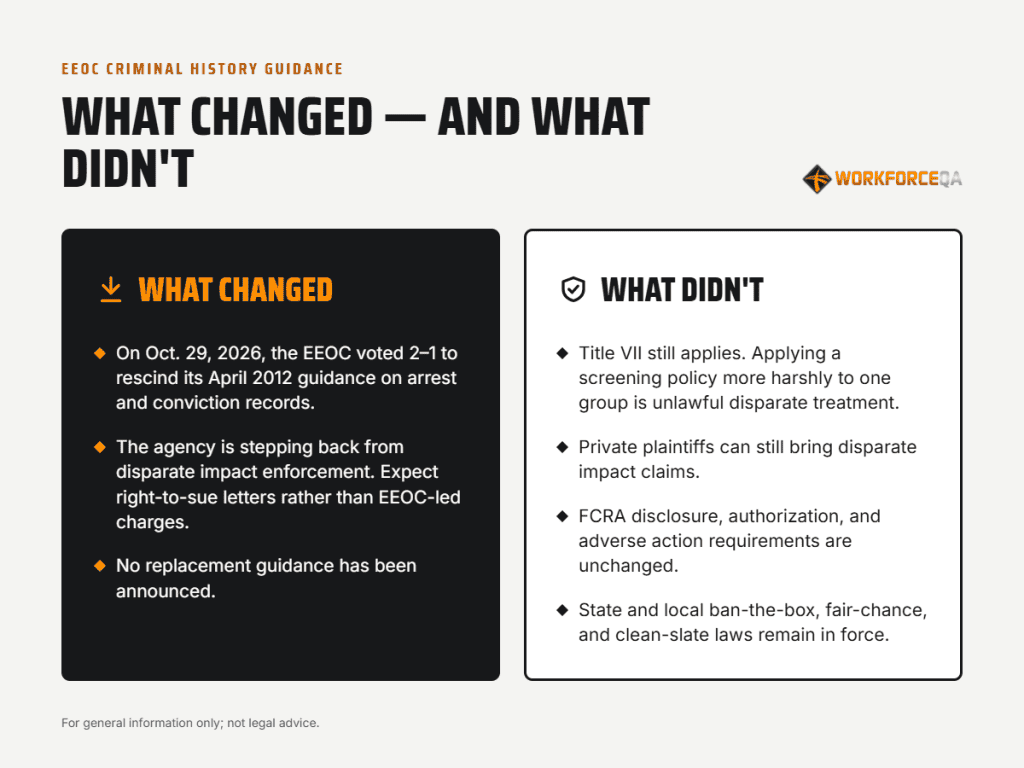
Although that guidance has now been withdrawn, Title VII’s prohibition against employment discrimination remains in effect.
Why Individualized Consideration Still Matters
One of the most important principles in the former EEOC guidance was the value of evaluating criminal history in context.
Not every conviction raises the same level of concern, and a record relevant to one position may have little connection to another.
The former guidance encouraged employers to consider three factors when evaluating criminal history:

The nature and seriousness of the offense. What was the offense, and how does it relate to the responsibilities of the position?
The time that has passed. How long ago did the offense occur, and how much time has passed since any sentence was completed?
The nature of the job. Does the offense have a meaningful connection to the duties, responsibilities, or environment of the position?
These considerations can help employers make more informed hiring decisions and avoid treating every criminal record as an automatic disqualifier.
While the rescinded guidance is no longer the EEOC’s enforcement framework, employers should not assume that abandoning these practices eliminates risk.
State and Local Laws Still Apply
Perhaps the most important consideration for employers is that the EEOC’s decision does not override state and local background screening laws.
Many jurisdictions have established their own requirements governing the use of criminal history in employment decisions. Depending on where an organization operates, these laws may address:
- When employers can request or consider criminal history.
- Which types of records may be considered.
- Whether individualized assessments are required.
- What information must be provided to applicants.
- What procedures must be followed before an adverse employment decision is finalized.
Fair Chance and Ban-the-Box laws, for example, may restrict when employers can consider criminal history during the hiring process. Requirements vary by jurisdiction, and employers operating across multiple states may need to account for several different sets of rules.
A change in federal enforcement priorities does not remove those requirements.
The Fair Credit Reporting Act Has Not Changed
Employers that use a third-party background screening provider must also continue to comply with the Fair Credit Reporting Act (FCRA).
When a background check is obtained through a consumer reporting agency, the FCRA establishes specific responsibilities for employers, including:
- Providing the required disclosure and obtaining authorization before requesting a report.
- Following the pre-adverse action process when information in a report may lead to an adverse employment decision.
- Providing the applicant with a copy of the report and the required summary of rights.
- Completing the adverse action process when a final decision is made.
These obligations remain in place regardless of the EEOC’s decision to rescind its 2012 guidance.
What Should Employers Do Now?
Rather than making immediate changes to screening policies based solely on the EEOC announcement, employers should use this development as an opportunity to review their current practices.
Consider the following steps:
- Review your criminal background screening policy.
Make sure your policy clearly explains how you evaluate criminal history and how you apply decisions across positions. - Understand the laws where you hire.
Review applicable state and local requirements, particularly if your organization hires across multiple jurisdictions. - Evaluate records in context.
Consider the relationship between the offense, the time elapsed, and the position’s responsibilities instead of relying on automatic exclusions. - Maintain consistent procedures.
Apply screening standards consistently and document the business-related reasons behind employment decisions. - Confirm FCRA compliance.
Make sure your disclosure, authorization, pre-adverse action, and adverse action procedures are current. - Work with an experienced background screening partner.
A knowledgeable screening provider can help employers understand their screening options, obtain relevant information, and support a consistent process.
Background Screening Is Still About Making Informed Decisions
The EEOC’s rescission of its 2012 guidance signals a change in federal enforcement priorities, but it does not make criminal background screening less complex.
Employers still need to balance hiring needs, workplace safety, compliance requirements, and fair consideration of applicants. That requires more than simply identifying whether a criminal record exists. It requires understanding the information, considering its relevance, and following applicable laws.
At WorkforceQA, we help employers navigate the background screening process with accurate, timely screening solutions and experienced support. Our approach combines background screening expertise, compliance-focused processes, and a connected platform designed to help organizations manage workforce screening, safety, and compliance.
The regulatory landscape may change, but informed hiring decisions and responsible screening practices remain essential.
Ready to take a closer look at your background screening program? Connect with WorkforceQA to learn how our background screening solutions can support your hiring and compliance needs.