

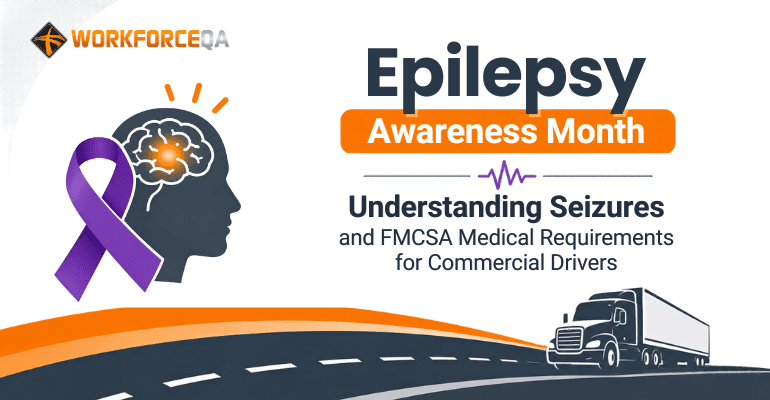
November is Epilepsy Awareness Month, an opportunity to increase understanding of epilepsy, recognize the importance of seizure awareness and highlight how neurological conditions can affect workplace and transportation safety.
Epilepsy affects millions of people across the United States. For employers, commercial motor vehicle (CMV) drivers and individuals pursuing a commercial driving career, understanding seizures and the related Federal Motor Carrier Safety Administration (FMCSA) medical qualification standards is especially important.
At WorkforceQA, we support employers with DOT physicals and occupational health services that help maintain a safe, healthy and compliant workforce. Understanding the connection between epilepsy, seizures and DOT medical certification is an important part of that conversation.
What Is Epilepsy?
Epilepsy is a neurological disorder characterized by a tendency to experience recurring, unprovoked seizures. It is one of the most common neurological disorders, and approximately 1 in 26 people will develop epilepsy during their lifetime. An estimated 3.4 million people in the United States are living with the condition.
A seizure occurs when there is a sudden surge of abnormal electrical activity in the brain that temporarily disrupts normal communication between brain cells. Seizures can affect awareness, movement, sensation, and behavior, and symptoms vary depending on the area of the brain involved.
Epilepsy is generally classified into four main types:
1 – Focal Epilepsy
Focal seizures begin in a specific area or network on one side of the brain. They may be classified as:
- Focal aware seizures: The individual remains conscious and aware of what is happening.
- Focal impaired awareness seizures: The individual’s awareness or consciousness is altered.
Symptoms may include unusual sensations, changes in emotions, involuntary movements or twitching.
2 – Generalized Epilepsy
Generalized seizures involve widespread electrical activity affecting both sides of the brain from the beginning. Common types include:
- Absence seizures: Brief periods of staring or impaired awareness.
- Tonic-clonic seizures: Stiffening of the body followed by rhythmic shaking.
- Myoclonic seizures: Sudden, brief muscle jerks.
These seizures can affect awareness and motor control throughout the body.
3 – Combined Generalized and Focal Epilepsy
Some individuals experience both focal and generalized seizures at different times. Symptoms and seizure patterns can vary significantly.
4 – Unknown Onset Epilepsy
In some cases, there is not enough information to determine where or how a seizure began. Clinicians may classify the seizure type as unknown until more information becomes available.
What Is the Difference Between a Seizure and Epilepsy?
Although the terms are sometimes used interchangeably, a seizure and epilepsy are not the same thing.
A seizure is an event involving abnormal electrical activity in the brain. A person can experience a single seizure without having epilepsy. Certain medical conditions or temporary circumstances can trigger a seizure, including:
- High fever
- Head trauma
- Very low blood sugar
- Low blood sodium
- Kidney or liver failure
- Alcohol or drug withdrawal
- Certain medications or acute medical conditions
Epilepsy, on the other hand, is a neurological disorder involving an ongoing tendency to experience unprovoked seizures.
This distinction matters when evaluating an individual’s medical history, particularly when determining whether a past event affects eligibility for safety-sensitive work or commercial driving.
Seizure First Aid: Remember the Three C’s
Knowing how to respond when someone experiences a seizure can help prevent injuries and ensure the person receives appropriate care.
Remember the three C’s: Calm, Cushion and Call.
Calm: Stay calm and take note of when the seizure begins. Do not attempt to hold the person down or restrain their movements.
Cushion: Gently place something soft, such as folded clothing, under the person’s head. Move nearby sharp or dangerous objects away. Never put anything in the person’s mouth.
Call: Call 911 if the seizure lasts longer than five minutes, the person has trouble breathing or waking afterward, it is their first known seizure, another seizure follows, or they are injured.
Remain with the person until they are alert and able to respond. If possible, gently turn them onto their side once it is safe to do so.
Epilepsy, Seizures and DOT Physicals: What Commercial Drivers Need to Know
For individuals who operate commercial motor vehicles in interstate commerce—or those pursuing a commercial driving career—epilepsy and seizure history can have an important impact on DOT medical certification.
The FMCSA addresses epilepsy, seizures and other conditions that may cause loss of consciousness under 49 CFR §391.41(b)(8).

The regulation states that a driver must have no established medical history or clinical diagnosis of epilepsy or another condition likely to cause loss of consciousness or loss of the ability to control a commercial motor vehicle.
The FMCSA Medical Examiner’s Handbook provides additional guidance for Certified Medical Examiners when evaluating an individual’s history.
How Different Seizure Histories May Affect DOT Medical Qualification
The medical examiner evaluates the individual’s specific medical history, diagnosis, treatment and risk of recurrence. The following distinctions are important:
History of epilepsy or a seizure disorder
Under FMCSA medical advisory criteria, an individual with a medical history of epilepsy or a seizure disorder may be considered for certification under the standard if they have been both:
- Seizure-free for at least 10 years.
- Off antiseizure medication for at least 10 years.
An individual with a current clinical diagnosis of epilepsy or a seizure disorder, or who is taking antiseizure medication to prevent seizures, generally does not meet the standard unless an applicable federal exemption is granted.
Single unprovoked nonepileptic seizure
A single unprovoked seizure does not automatically mean an individual has epilepsy. Under the Medical Examiner’s Handbook, an individual who has experienced a single unprovoked nonepileptic seizure may be considered for certification after being both seizure-free and off antiseizure medication for at least five years.
Single provoked nonepileptic seizure
A single provoked seizure may be evaluated differently when there is a known medical condition or identifiable trigger that is reversible or avoidable.
Examples may include a medication reaction, high fever, acute infection, dehydration, alcohol or drug withdrawal, or an acute metabolic disturbance.
A medical examiner may consider certification when the individual has fully recovered, has no residual complications, is not taking antiseizure medication and the likelihood of recurrence or future exposure to the triggering condition is low.
These are general FMCSA guidelines, not automatic guarantees of certification. The Certified Medical Examiner evaluates each driver’s circumstances and determines whether the applicable medical qualification standard is met.
Can a Commercial Driver With Epilepsy Apply for an FMCSA Exemption?

Yes. The FMCSA has a Federal Seizure Exemption Program for certain interstate commercial drivers who do not meet the standard medical qualification requirements under 49 CFR §391.41(b)(8).
The exemption process requires a detailed review of the driver’s medical history and supporting documentation. Depending on the individual’s circumstances, requested information may include:
- A statement from the treating physician describing the diagnosis, seizure history and medication status.
- Recent medical records and examination notes.
- Relevant laboratory and diagnostic testing results.
- A copy of the driver’s license.
- Motor vehicle records and driving history.
- Additional information requested by the FMCSA.
The FMCSA has specific criteria for applicants with epilepsy, a single unprovoked seizure and a single provoked seizure. Those criteria differ from the medical certification guidelines used by a Certified Medical Examiner.
The application must be complete. The FMCSA will not begin processing an incomplete application. Once a completed application is received, the agency may take up to 180 days to issue a decision.
Drivers who need a federal seizure exemption must not operate an interstate CMV under that exemption while waiting for a decision. They must receive approval and meet the applicable requirements before operating under an exemption.
Drivers can find the current application and supporting documentation requirements on the FMCSA website:
The Role of DOT Physicals and Occupational Health Services
For employers in transportation and other safety-sensitive industries, medical qualification is an important part of workforce safety and regulatory compliance.
DOT physicals help determine whether commercial drivers meet the applicable FMCSA medical standards. When a driver reports a history of seizures, epilepsy or loss of consciousness, the medical examiner may need additional medical documentation or specialist information to make an informed qualification decision.
Employers should also understand that a past seizure does not automatically mean every individual will have the same medical qualification outcome. The nature of the event, underlying diagnosis, treatment history, recovery and likelihood of recurrence all matter.
WorkforceQA helps employers coordinate workforce screening, safety and compliance services, including:
DOT physicals: Medical examinations conducted through qualified medical examiner resources to evaluate drivers against applicable DOT medical standards.
Occupational health services: Access to medical services that support employee health, fitness-for-duty needs and workplace safety.

Drug and alcohol testing: DOT and non-DOT testing services to support employer compliance and workplace safety programs.
Medical review services: Medical Review Officer (MRO) review as part of applicable drug testing programs.
By bringing these services together through one connected platform, WorkforceQA helps employers streamline workforce health and compliance processes while keeping important employee and driver information organized.
Supporting Awareness, Safety and Compliance
Epilepsy Awareness Month is a reminder that understanding neurological conditions can make a meaningful difference – in the workplace, on the road and throughout our communities.
For commercial drivers, knowing the FMCSA medical requirements and understanding the importance of accurate medical documentation can help prevent confusion during the DOT physical and certification process.
For employers, partnering with experienced workforce screening and occupational health providers helps support informed decisions, regulatory compliance and a safer workforce.
WorkforceQA helps employers bring workforce screening, safety and compliance together – from DOT physicals and occupational health services to drug and alcohol testing and background screening.
Need help managing DOT medical certification and occupational health requirements? WorkforceQA provides connected occupational health and compliance solutions to help employers support a safe, compliant workforce.
Visit WorkforceQA to learn more.
FMCSA Medical Guidelines & Resources:
FMCSA NATIONAL REGISTRY OF CERTIFIED MEDICAL EXAMINERS – Medical Examiner’s Handbook 2024 Edition
Disclaimer: This article is for informational purposes only and is not intended to provide medical or legal advice. Medical certification decisions are made by qualified medical professionals based on applicable FMCSA regulations and individual circumstances. Employers and drivers should consult appropriate medical, legal, or regulatory professionals for guidance specific to their situation.