


For decades, background screening has followed a simple model: run the check once, at the point of hire, and consider the box checked. But for employers in safety-sensitive and regulated industries – trucking, transit, aviation, construction, and industrial operations – that model is no longer enough.
A criminal record, a license status, or a driving record can change the day after a background check clears. If your screening program only looks at a single moment in time, it’s blind to everything that happens after. That’s the gap continuous lifecycle screening is designed to close – and it’s quickly becoming the new compliance standard for regulated employers.
What Is Continuous or Lifecycle Screening?
Continuous (or lifecycle) screening extends background checks beyond the hiring moment and into ongoing employment. Instead of a single point-in-time snapshot, employers build recurring monitoring into their compliance programs, typically including:
- Periodic criminal record checks throughout the employment relationship, not just pre-hire
- License and credential verification, ensuring certifications, CDLs, and other qualifications remain active and in good standing
- Motor Vehicle Record (MVR) monitoring for drivers and other safety-sensitive personnel, often in near-real time
- Recurring compliance audits tied to the risk level of each role
Rather than treating screening as a hiring gate, employers are increasingly treating it as an ongoing risk-management function – one that runs in parallel with employment, not just at its start.
Why the Shift Is Happening Now
A few forces are converging to push employers toward continuous models:
- Risk doesn’t stay still. A new traffic violation, a lapsed certification, or a new criminal charge can happen at any point during someone’s tenure. A background check from two or three years ago tells you nothing about today.
- Regulatory and liability exposure is growing. Employers in DOT-regulated industries in particular face mounting expectations – from FMCSA and other regulators – to demonstrate ongoing diligence, not just a one-time hiring decision. When an incident occurs, “we checked at hire” is an increasingly weak defense if the disqualifying event happened well before the incident and was never caught.
- Role-based and risk-based screening is maturing. As one-size-fits-all screening packages give way to more tailored, risk-based approaches, it’s a natural extension to apply that same risk-based thinking to when checks happen – not just what they check.
- Technology has made it feasible. Continuous MVR monitoring, automated license verification, and criminal record alert systems have matured to the point where ongoing monitoring is operationally realistic, not just theoretically nice-to-have.
Why It Matters Most for DOT-Regulated Employers
For trucking fleets, transit agencies, FAA-regulated airlines, and other safety-sensitive operations, compliance gaps can have serious consequences.
Consider a driver whose license is suspended mid-year or who accumulates a serious moving violation. Under a traditional annual-review model, that information might not surface until the next scheduled check -potentially months later, leaving an employer unaware that a driver’s eligibility or safety record has changed.
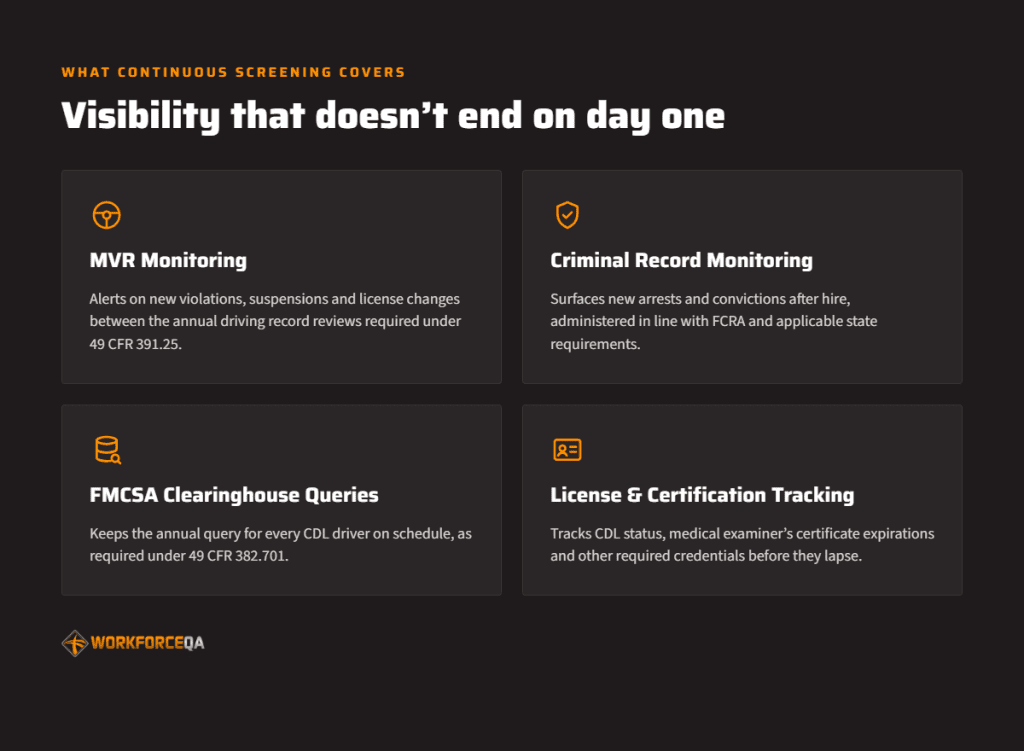
Federal regulations establish the baseline, not necessarily the entirety of an employer’s ongoing compliance program. For example, FMCSA regulations require motor carriers to obtain and review an MVR for each driver at least once every 12 months (49 C.F.R. § 391.25). Many employers are building additional monitoring and credential-management practices around these baseline requirements rather than relying solely on an annual review.
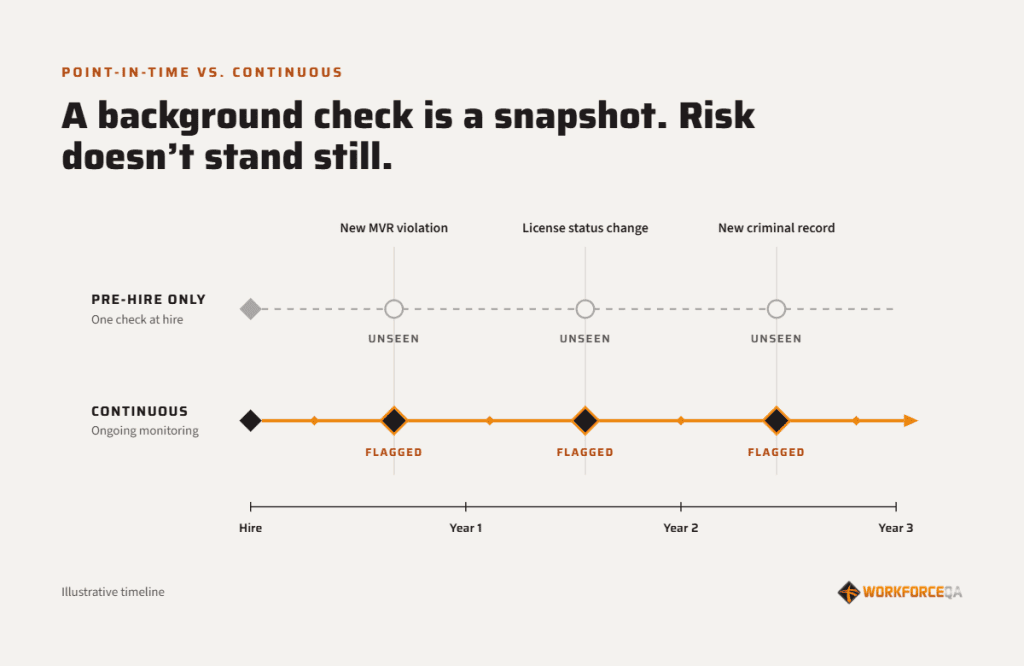
Continuous MVR monitoring helps close that window. Rather than waiting for an annual pull, employers can be alerted when new violations or license-status changes are reported, allowing them to review the information and take appropriate action sooner.
The same lifecycle approach applies to background screening and credential management across regulated and safety-sensitive operations. A change in driving eligibility, an expired or lapsed license or certification, a change in medical qualification, or another potentially disqualifying record can create compliance concerns between scheduled reviews. Ongoing monitoring helps employers identify these changes as they occur—not months later.
The Broader Industry Shift
This move isn’t limited to fleet safety. Across background screening, employers are increasingly extending screening beyond the point of hire, particularly for roles involving safety, financial responsibility, or regulatory oversight, with periodic criminal record checks, license verification, and compliance audits supplementing the traditional pre-hire check. That shift runs alongside a related trend: employers moving away from blanket, one-size-fits-all screening policies toward role- and risk-based approaches that focus monitoring where the consequences of missing something are highest.
What We Heard from Clients at our Recent Roundtable: The Need for Ongoing Visibility
At our 2026 Safety, Screening & Compliance Roundtable in Nashville, one theme kept coming up in conversations with clients across trucking, transit, and industrial sectors: what happens between checks matters. Employers told us that while annual and point-in-time screening remains an important part of compliance, they want greater visibility into changes that can occur after an employee is cleared to work.
What Employers Should Do Next
If your organization is still relying primarily on point-in-time background checks, here’s where to start:
- Audit your current screening cadence. Identify which roles are checked only at hire versus which (if any) are monitored on an ongoing basis.
- Identify your highest-risk roles first. Safety-sensitive positions – drivers, equipment operators, anyone operating under DOT authority – are the natural starting point for continuous monitoring, since the cost of a missed disqualifying event is highest there.
- Evaluate your credentialing tracking. Do you have a reliable system for knowing when a license, certification, or DOT physical is set to expire – before it lapses, not after?
- Talk to your screening partner about lifecycle options. Continuous MVR monitoring, recurring criminal record checks, and automated credential tracking can often be layered onto an existing screening program without a full rebuild.
- Document your rationale. As regulatory and litigation expectations around ongoing diligence increase, a documented, risk-based monitoring policy, not just an ad hoc practice, will matter if your program is ever scrutinized.
The Bottom Line
Background screening built for a single moment in time is increasingly out of step with the risks employers actually face. For regulated industries where safety and compliance carry real consequences, moving from a point-in-time check to a continuous, lifecycle approach isn’t just a best practice – it’s becoming the standard employers are expected to meet.
How WorkforceQA Can Help
Building a continuous, lifecycle screening program doesn’t have to mean overhauling your entire process. WorkforceQA brings screening, monitoring, credentialing, and compliance together in one platform, helping employers maintain visibility throughout the employee lifecycle—not just at the point of hire or during an annual review.
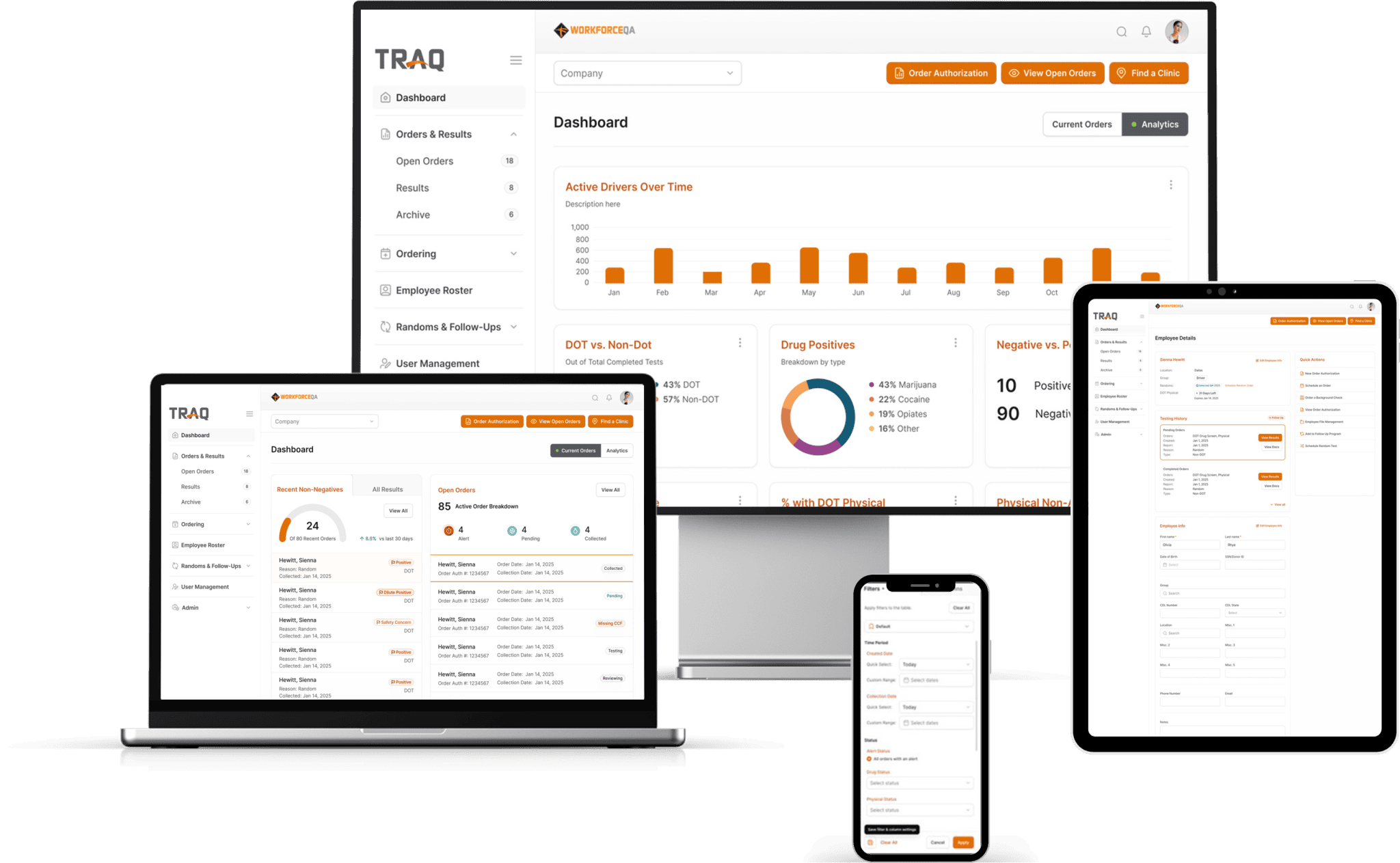
We work with trucking, transit, airlines, and other safety-sensitive employers to layer ongoing monitoring onto existing compliance programs, including:
- Continuous MVR monitoring that flags new violations or license changes as they post, rather than waiting for the next scheduled pull
- Background screening programs built around role-based risk and regulatory requirements, rather than one-size-fits-all packages
- Credential and certification tracking to help identify lapses in licenses, medical certifications, and other job-specific qualifications before they become compliance gaps
- Regulatory and compliance support to help employers manage evolving requirements across FMCSA, FAA, and other applicable regulatory frameworks
The result is a more connected approach to workforce compliance—giving employers greater visibility into changes that can occur after an employee is cleared and helping them act before a compliance issue becomes a bigger problem.
Don’t wait for the next scheduled check to find out what changed. Talk with WorkforceQA about building a continuous screening and compliance strategy that gives you greater visibility throughout the employee lifecycle.
Want to dig deeper into this and other takeaways from our 2026 Safety, Screening & Compliance Roundtable? Watch the on-demand webinar, From Insight to Action: 2026 Safety, Screening & Compliance Takeaways, featuring insights and practical takeaways from the conversations held in Nashville.
Sources & Further Reading
- Federal Motor Carrier Safety Regulations, 49 C.F.R. § 391.25 – Annual Inquiry and Review of Driving Record: law.cornell.edu

