


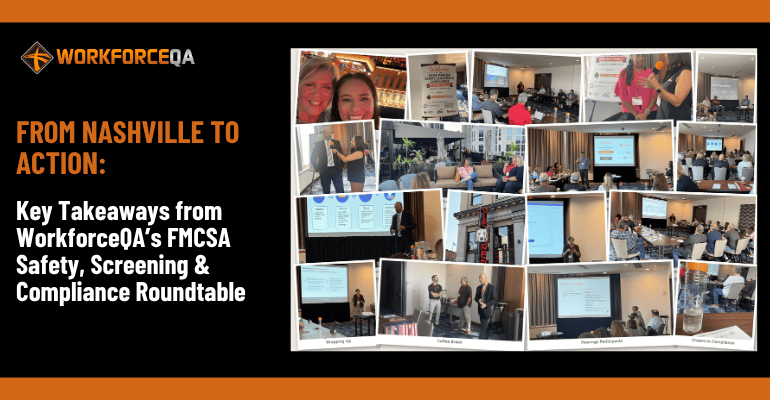
What happened in Nashville doesn’t stay in Nashville. The conversations and insights from WorkforceQA’s 2026 Safety, Screening & Compliance Roundtable offer practical takeaways for employers navigating today’s safety, screening, and compliance challenges.
Rather than a traditional conference filled with back-to-back presentations, the Roundtable was designed to create something different: an intimate, peer-to-peer environment where industry professionals could ask questions, share experiences, and talk openly about the challenges they face every day.
And that’s exactly what happened.
Following the event, WorkforceQA hosted a recap webinar with Grady Phillips, Chief Revenue Officer; Bianca Lager, Head of Marketing; Lance Shaw, DER & Compliance Specialist with Tyson Foods; and Tracy Rushing, CDS, Executive Director of Safety & HR with R.E. Garrison, to revisit some of the conversations and takeaways from Nashville.
Here are a few of the highlights.
A Conversation Directly with FMCSA
One of the most valuable parts of the Roundtable was having Bryan Price, Chief of the Drug and Alcohol Program Division at FMCSA, join the group for an open discussion.
For attendees, the opportunity went beyond simply hearing regulatory updates. It provided a chance to ask questions, explain real-world challenges, and hear directly from someone involved in administering the programs that affect their day-to-day responsibilities.
For Tracy Rushing, that direct access was one of the most valuable parts of the experience.
“I think it was invaluable.”
Lance Shaw agreed that having the opportunity to ask questions directly and get clarification from FMCSA was a meaningful part of the discussion.
“I think it was great to have those straight answers.”
One topic that generated significant discussion was the FMCSA Clearinghouse and pre-employment queries, particularly how information about a driver’s follow-up testing requirements is presented.
The group also discussed the process for drivers who need to complete a return-to-duty process but are not currently employed by a motor carrier. While the process can be challenging, understanding the requirements and available pathways matters for both employers and drivers.
The takeaway? Understanding the process matters—for employers and for drivers trying to return to safety-sensitive work.
Hair Testing: A Real-World Employer Perspective
One of the most talked-about sessions in Nashville was the discussion around hair testing.
Lance shared Tyson Foods’ experience using hair testing as an additional component of its pre-employment screening program. His willingness to share real-world results gave attendees a chance to look beyond whether to use hair testing and instead consider how an employer’s testing strategy can affect its broader safety program.
Lance explained that Tyson uses hair testing alongside its DOT-required testing program. The discussion gave other employers an opportunity to ask questions and hear how a large carrier incorporates an additional testing method into its overall screening strategy.
The important distinction is that hair testing is not a substitute for DOT-required testing. Employers operating DOT-regulated programs must continue to follow applicable federal testing requirements.
For employers, the discussion raised a larger question:
What additional screening tools can help you make better-informed hiring decisions while maintaining a compliant testing program?
That conversation – and the data and experiences shared by employers actually using these programs – is exactly the kind of practical discussion the Roundtable was created to encourage.
What Happens When the Room Starts Talking?
Perhaps the most meaningful takeaway from Nashville came during the peer-to-peer discussion.
As the second day progressed, attendees became more comfortable sharing their experiences. Questions turned into conversations. One employer’s challenge became another employer’s solution.
Tracy described the value of hearing directly from other carriers and taking those real-world examples back to her team.
“It was really valuable to hear what other carriers were doing.”
That exchange was one of the goals behind the Roundtable format. Rather than simply bringing information back from a conference, attendees could hear how other employers were handling similar challenges and consider what might work within their own organizations.
Lance made a similar observation. Once the group became comfortable opening up, he felt the conversation could have continued much longer.
“I wish we would have opened up sooner.”
And, as he put it, the group could have kept the conversation going for “another two days.”
That’s the difference WorkforceQA wanted to create.
Not another conference where everyone listens and leaves. A room where people actually talk to each other.
SAP, Return-to-Duty and the Human Side of Compliance
The Roundtable also included a thoughtful discussion with Nicole Hanratty, CEAP, SAP, SAE · Chief Operating Officer, American Substance Abuse Professionals (ASAP), around substance abuse professional programs and the return-to-duty process.
While the regulatory requirements are clear, the conversation also highlighted something that can sometimes get lost in the compliance process: there is a person behind every test result and every Clearinghouse record.
Tracy Rushing brought that perspective to the conversation. As someone who works closely with drivers, she spoke about the importance of understanding what drivers go through when they navigate the SAP and return-to-duty process.
For Tracy, driver safety and driver advocacy aren’t competing ideas. They are part of the same conversation.
She shared how much she appreciated hearing Nicole’s perspective and the passion she brings to helping drivers navigate the process. Tracy’s comments reflected a genuine concern for giving drivers the information, guidance, and support they need to understand what comes next.
That perspective resonated with the broader discussion: compliance doesn’t have to mean losing sight of the person you’re trying to help.
Employers approach these situations differently. Some operate under zero-tolerance policies, while others may have programs that allow eligible drivers to return to work after completing the required process. Lance Shaw explained that Tyson maintains a zero-tolerance policy but will consider drivers who have successfully completed the required return-to-duty and follow-up process.
The important distinction is understanding the difference between what the regulations require and what an individual employer’s policies allow.
For employers, that means having a clear process, knowing the requirements, and making sure drivers understand their options and responsibilities.
For drivers, it can mean the difference between receiving a notice that they violated a requirement and understanding how they can move forward.
That was one of the most meaningful parts of Tracy’s perspective throughout the Roundtable: behind every compliance issue is a driver, a career, and a person who deserves to be treated with respect while still meeting safety requirements.
That balance—protecting the public, maintaining rigorous safety standards, and treating drivers with respect—is not always easy.
But it is a conversation worth having.
Marijuana, Impairment and the Future of DOT Testing
Another major topic was the evolving conversation around marijuana, impairment, and the future of DOT drug and alcohol testing.
Dr. Donna Smith, WorkforceQA’s Regulatory Compliance Advisor, provided attendees with insight into the regulatory landscape and the ongoing discussions surrounding marijuana policy and drug-testing requirements.
For employers, the key is to distinguish between changes being discussed or considered and the requirements that currently apply to their DOT-regulated workforce.
The Roundtable discussion also highlighted a question that will continue to be important for safety-sensitive employers:
How do we address impairment and protect public safety as laws, policies, and testing technologies continue to evolve?
There isn’t a simple answer, which is exactly why continued industry dialogue is so important.
What About Oral Fluid Testing?
Oral Fluid Testing: Watching for the Next Step
Dr. Donna Smith provided an update on the regulatory and implementation landscape for oral fluid testing.
The technology and regulatory framework for oral fluid testing are already in place, but one key piece is still needed before DOT-regulated employers can begin using the method: HHS-certified oral fluid laboratories. Under DOT regulations, an HHS-certified laboratory must test oral fluid specimens, and the collection device must be approved for use by that laboratory. DOT also requires at least two HHS-certified oral fluid laboratories before employers can implement oral fluid testing, ensuring the required primary and split-specimen testing.
For employers, this remains an area to watch closely. As HHS certification progresses and the laboratory infrastructure develops, oral fluid testing could provide DOT-regulated employers with another testing option. Until the required laboratory certifications are in place, however, DOT-regulated employers should continue following currently authorized testing processes.
WorkforceQA will continue monitoring developments and keep employers informed as the regulatory landscape moves forward.
For now, employers should continue following current DOT testing requirements while watching for updates from HHS and DOT on when oral fluid testing can proceed.
The Value of Getting the Right People in the Same Room
If there was one theme that carried through the entire Roundtable, it was this:
The best conversations often happen after the presentation ends.
Bringing together an FMCSA representative, safety leaders, compliance professionals, employers, testing experts, and WorkforceQA subject-matter experts created an opportunity to answer questions from multiple perspectives.
For Tracy, the intimate setting was a big part of what made the experience valuable. Instead of being one person in a crowded conference room, attendees had the opportunity to participate in a genuine conversation.
And Lance’s comments captured what happened as those conversations developed: the more comfortable people became, the more they shared.
Sometimes, the most valuable takeaway wasn’t a new regulation or a new technology.
It was hearing, “We’ve dealt with that, too.”
Or, “Here’s what worked for us.”
Or simply, “Have you considered this?”
Those conversations can lead to better questions, better processes, and better-informed decisions back at the employer level.
Taking the Conversation Beyond Nashville
The WorkforceQA Safety, Screening & Compliance Roundtable was built around collaboration, and the conversations in Nashville reinforced why that matters.
Regulations continue to evolve. Technology continues to change. Employers are facing new challenges around recruiting, screening, compliance, drug and alcohol testing, and maintaining safe workforces.
No single organization has all the answers.
But bringing the right people together – and creating an environment where they can share what they’re seeing and learning – can move the conversation forward.
And we’re not done yet.
WorkforceQA plans to bring the Roundtable back in 2027, with Nashville returning as the home of this unique industry gathering. WorkforceQA has already announced that the 2027 event will return to Nashville, with details coming soon.
In the meantime, if you missed the Nashville Roundtable, you can watch the WorkforceQA Safety, Screening & Compliance Roundtable Recap Webinar to hear directly from Grady, Bianca, Lance, and Tracy as they revisit the conversations, challenges, and insights from the event.
Because the most valuable conversations don’t always happen from a stage.
Sometimes, they happen around the table.
Ready to Simplify Your Screening & Compliance Program?
Managing background screening, drug & alcohol testing, occupational health, and compliance across multiple providers can get complicated.
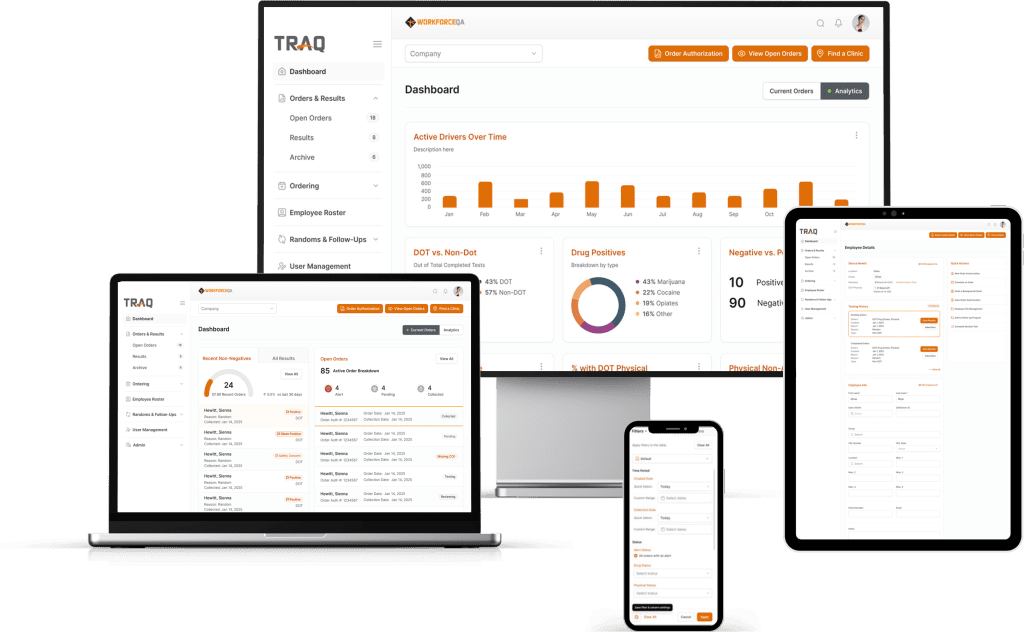
Talk with a WorkforceQA representative to see how our all-in-one platform can bring your programs together in one place.
See What WorkforceQA Can Do for Your Team →


