


FMCSA Temporary Waiver: Paper Medical Certificates Expired October 11, 2027
FMCSA’s Temporary NRII Exemption Has Expired: What Drivers and Carriers Need to Know
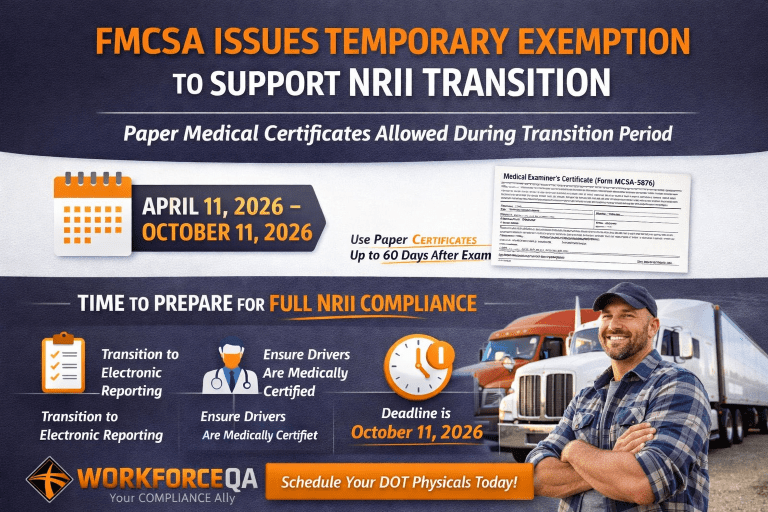
The FMCSA’s temporary exemption allowing commercial driver’s license (CDL) and commercial learner’s permit (CLP) holders and motor carriers nationwide to use a paper medical examiner’s certificate as proof of medical certification expired on October 11, 2026.
Effective October 12, 2026, drivers licensed in all states except Alaska can no longer rely on a paper medical examiner’s certificate for this purpose. Medical certification information is now transmitted electronically to state driver’s licensing agencies under the National Registry II (NRII) system.
Alaska exception: FMCSA renewed a limited exemption for Alaska-licensed CDL and CLP holders and their motor carriers through October 12, 2027. The exemption allows them to rely on a valid paper medical examiner’s certificate for up to 60 days after issuance, subject to the exemption’s conditions.
Employers should review their driver qualification file procedures and confirm that medical certification information is being verified through the appropriate electronic records.
Stay Up to Date on FMCSA Medical Certification Requirements
Read our latest blog for the current FMCSA requirements, what the expiration means for drivers and carriers, and the Alaska exception.
Read the Latest Update → BLOG: FMCSA Medical Cert Update
3 Key Reminders to Stay Compliant Under the Waiver
1) Keep the MEC in the Driver Qualification File (DQF)
If your company is relying on the paper MEC to allow the driver to operate during this waiver period, the motor carrier must have a copy of the MEC in the driver’s qualification file.
WorkforceQA tip: Make sure your DQF process includes immediate intake and filing of the new MEC the same day it’s received.
2) Drivers Must Carry the MEC While Operating
Drivers must have a copy of the Medical Examiner’s Certificate in their possession at all times when operating a commercial motor vehicle.
WorkforceQA tip: Add “paper MEC present” to your dispatch or pre-trip checklist during the waiver period to reduce roadside compliance risk.
3) If CDLIS Doesn’t Match, You Must Verify Before the 60 Days Ends
If the driver’s license is issued in a state that has already implemented NRII, but the driver’s CDL MVR/CDLIS record fails to reflect the most recent medical certification information (including the DOT physical date and MEC expiration date), the motor carrier must:
✅ Before the 60-day waiver grace period ends, have a copy of the driver’s CDLIS from the SDLA showing that the most recent medical certificate has transmitted from the National Registry to the SDLA—and that the driver is medically certified.
WorkforceQA tip: Don’t wait until day 55. Build a workflow that triggers record verification and follow-up within the first 2–3 weeks after the DOT physical.
Why This Matters: Compliance Risk + Operational Downtime
Even with a waiver in place, medical certification issues can create real business impact:
- Drivers pulled OOS due to missing or mismatched medical certification records
- Audit findings due to incomplete DQFs
- Delayed hiring/onboarding when certification status isn’t reflected properly
- Increased admin time chasing documentation across locations and states
- Roadside inspection complications due to unavailable proof of certification
The waiver provides flexibility—but only if motor carriers maintain clean documentation and proactive verification.
How WorkforceQA Can Help
WorkforceQA helps motor carriers keep drivers moving by managing DOT Background Checks, Drug and Alcohol Testing and DOT physicals, supporting physical reviews, and helping ensure medical certification documentation is handled correctly—especially when FMCSA issues temporary waivers like this one.
Want to reduce admin time and prevent driver downtime?
WorkforceQA supports carriers with DOT physical coordination and physical reviews so your team can focus on safe operations—not chasing paperwork.
✅ Improve audit readiness
✅ Strengthen medical certification workflows
✅ Reduce driver downtime caused by compliance gaps