

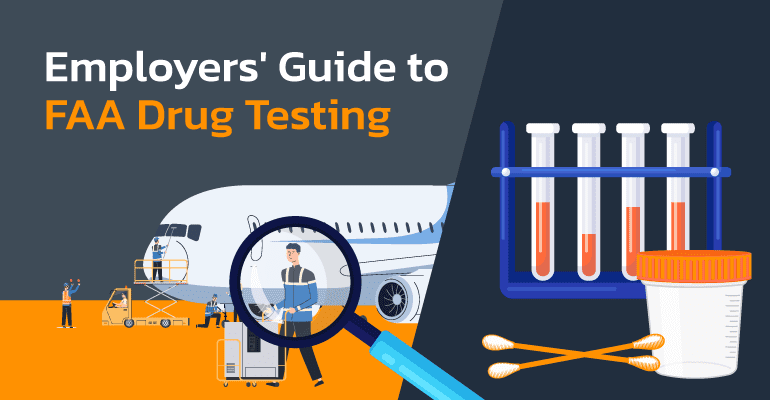
Aviation employers operate in one of the most safety-critical industries in the world. From aircraft maintenance and dispatch to flight operations and aviation security, employees in safety-sensitive roles directly affect public safety. That’s why the Federal Aviation Administration (FAA) requires drug and alcohol testing—and why compliant program management is essential.
FAA drug testing requirements are governed by 14 CFR Part 120 and incorporate standardized Department of Transportation (DOT) procedures under 49 CFR Part 40. These regulations define who must be tested, when testing occurs, what substances are screened, and how employers must document compliance.
WorkforceQA supports aviation employers in maintaining FAA compliance through program management, drug and alcohol testing, random pool management, nationwide testing coordination, and audit-ready documentation. Our services include compliance support, FAA-aligned background screening, and onsite testing at airports—powered by our extensive onsite collector network to ensure minimal operational downtime. Additionally, we offer in-house Medical Review Officer (MRO) services, assisted by experienced MRO staff to ensure fast, accurate results that meet DOT reporting standards.
What Is an FAA Drug Test?
An FAA drug test is part of a federally mandated program designed to prevent prohibited substance use among employees performing safety-sensitive aviation functions. While the FAA establishes program requirements under Part 120, all testing procedures must follow DOT rules in Part 40, including collections, chain of custody, laboratory analysis, medical review, and result reporting.
FAA-covered employees include aircraft maintenance technicians (AMTs), flight crew members, flight attendants, instructors, dispatchers, ground security coordinators, aviation screeners, operations control specialists, and certain non-FAA air traffic control personnel. Employers are responsible for ensuring all safety-sensitive employees are consistently included, regardless of schedule, employment status, or location.
WorkforceQA ensures FAA-compliant testing with precise collection coverage, minimizing gaps that could lead to compliance issues during FAA audits.
When Is FAA Drug Testing Required?
FAA-regulated employers must conduct drug and alcohol testing at specific points throughout employment.
Pre-Employment Testing
A verified negative drug test result is required before an employee performs any safety-sensitive duties. This applies to new hires and employees transferring into FAA-covered roles. WorkforceQA coordinates collections nationwide and tracks results to help prevent premature duty assignments.
Random Testing
Random testing is one of the most scrutinized areas of FAA compliance. Employers must use a scientifically valid, DOT-compliant random selection process. Testing must be unannounced and conducted while employees are performing—or available to perform—safety-sensitive functions.
FAA Random Testing Rates for 2026 (Unchanged):
- 25% drug testing
- 10% alcohol testing
WorkforceQA manages FAA-compliant random pools, selections, notifications, and documentation—making it easier to meet annual testing percentages without disrupting operations.
Reasonable Suspicion Testing
Reasonable suspicion testing is required when a trained supervisor observes signs of possible substance misuse related to appearance, behavior, speech, or job performance. Testing should occur promptly, and supervisors must complete DOT-required training. WorkforceQA supports supervisor training and compliant testing coordination.
Return-to-Duty & Follow-Up Testing
After a violation, employees must complete evaluation and treatment oversight by a DOT-qualified Substance Abuse Professional (SAP), receive a verified negative return-to-duty test, and complete follow-up testing for 12 to 60 months. WorkforceQA helps employers track these timelines accurately.
Airport Onsite Testing Coordination: Faster Collections, Less Downtime
Aviation doesn’t stop for testing—and sending employees offsite can cause avoidable delays, missed shifts, and operational strain. That’s why many aviation employers rely on onsite collections for pre-employment, random, post-accident, reasonable suspicion, and return-to-duty situations.
WorkforceQA provides onsite testing coordination in airports and aviation environments, including:
- Onsite collectors dispatched to airport locations
- Support for after-hours, weekend, and time-sensitive events
- DOT-compliant collections with proper chain-of-custody handling
- Centralized scheduling and documentation for audit readiness
With the largest onsite collector network, WorkforceQA helps aviation employers complete compliant testing quickly—reducing disruption while maintaining rigorous program integrity.
What Substances Are Tested in FAA Drug Testing?
FAA drug testing uses the DOT 5-panel drug test, which screens for:
- Marijuana (THC)
- Cocaine
- Amphetamines (including methamphetamine and MDMA)
- Opiates (including codeine, morphine, and heroin)
- PCP
WorkforceQA ensures all testing follows DOT laboratory and Medical Review Officer (MRO) requirements.
In-House MRO Services: Faster, Compliant Results Review
DOT testing requires results to be reviewed and verified by a Medical Review Officer (MRO) before an employer can treat a result as final. The MRO is responsible for evaluating lab results and determining whether there is a legitimate medical explanation when appropriate—using DOT rules and required documentation.
With WorkforceQA’s in-house MRO and dedicated MRO assistants, aviation employers benefit from:
- Streamlined result verification and reporting
- Consistent DOT/FAA-aligned documentation
- Reduced administrative handoffs between vendors
- Clear communication and support when results require additional review
This integrated approach helps employers stay compliant while keeping hiring and operations on schedule.
FAA Background Screening for Aviation Employers
Drug and alcohol testing is essential—but it’s only one part of a strong aviation compliance program. Employers also need confidence in who they’re bringing into secure facilities, safety-sensitive roles, and operational environments.
WorkforceQA provides FAA-aligned background screening services that integrate seamlessly into your hiring and compliance workflow. Screening programs are tailored to job roles and risk profiles and may include identity verification, criminal history checks, employment and education verification, and other role-appropriate screening components.
By managing background screening alongside FAA drug testing and onsite coordination, WorkforceQA helps aviation employers:
- Reduce onboarding delays
- Maintain consistent documentation
- Eliminate vendor fragmentation
- Strengthen defensibility during audits and inspections
What Happens After a Positive FAA Drug Test?
If an employee tests positive or refuses to be tested, the employer must immediately remove the employee from safety-sensitive duties. Required FAA/DOT steps include SAP referral (when applicable), documentation, and ensuring the employee does not return to duty until fully cleared.
WorkforceQA helps employers accurately manage post-violation steps, reducing compliance risk while maintaining proper records.
FAA Compliance Made Simple with WorkforceQA
FAA drug and alcohol testing compliance requires more than just ordering tests. Employers must manage random testing, supervisor training, documentation, reporting, background screening, and audit readiness—often across multiple locations and time-critical airport environments.
WorkforceQA provides end-to-end aviation compliance support, including:
- FAA & DOT-compliant program administration
- In-house MRO services with dedicated MRO assistants for efficient, compliant result verification and reporting
- Random pool management
- Nationwide testing coordination
- Airport onsite testing coordination through the largest onsite collector network
- Background screening integration
- Audit-ready documentation and reporting
If you need a consistent, inspection-ready FAA testing program that works across terminals, hangars, and multiple sites, WorkforceQA can help you build and manage it correctly.
Learn more about WorkforceQA’s aviation compliance services
FAA Drug Testing FAQs (Quick Answers)
What regulation governs FAA drug testing?
14 CFR Part 120, with DOT procedures under 49 CFR Part 40.
Who must be included in an FAA testing program?
Anyone performing FAA-defined safety-sensitive functions.
What are the FAA random testing rates for 2026?
25% drugs, 10% alcohol.
What drugs are tested?
DOT 5-panel: marijuana, cocaine, amphetamines, opiates, PCP.
Can an employee work before a pre-employment test is complete?
No—verified negative results are required first.
Who verifies FAA drug test results?
DOT drug test results must be reviewed by a certified Medical Review Officer (MRO) before they’re verified and reported to the employer. WorkforceQA provides in-house MRO support, including MRO assistants, to help ensure verification remains timely and compliant.
What happens after a positive test or refusal?
Immediate removal from safety-sensitive duties and completion of SAP/return-to-duty steps.
Do aviation employers use onsite collections?
Yes—onsite testing can reduce downtime and speed compliance events, especially in airports.
Is background screening required, too?
Many aviation employers add background screening to support secure, risk-aware hiring.
Key requirements include:
- 49 CFR Part 40 Compliance: Employers must request drug and alcohol records from previous DOT-regulated employers, covering 5 years for positive tests, 0.02 or greater alcohol results, and refusals.
- PRD (14 CFR Part 111): Employers must query the FAA’s PRD for pilot records, including training,, disciplinary action, and 49 CFR Part 40 records, to make hiring decisions.
- For non-pilot, safety-sensitive roles, the 49 CFR Part 40 process requires collecting specific, detailed drug and alcohol history from previous employers.
Learn More About WFQA’s Aviation Compliance Services
Discover how WorkforceQA can support your organization. Reach out to us today for more information about our aviation compliance services, resources, and more. Our team is ready to help.