

What Employers and DOT Programs Need to Know
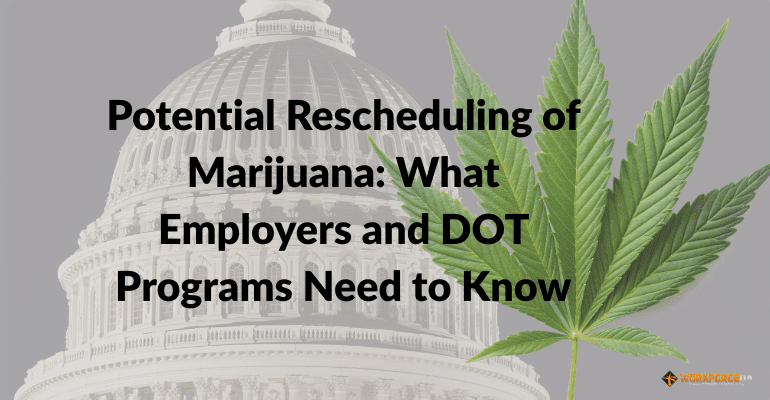
President Trump may sign an executive order as soon as tomorrow directing federal agencies to reclassify marijuana from Schedule I to Schedule III under the Controlled Substances Act. While the change is being celebrated by the cannabis industry, it raises urgent questions for employers—especially those responsible for drug testing, DOT compliance, and safety-sensitive workforces.
Why This Matters for Workplace Drug Testing
Federal workplace drug testing programs—particularly those governing Department of Transportation (DOT) and other government-regulated safety-sensitive positions- have long relied on marijuana’s Schedule I status. Truck drivers, pilots, transit operators, railroad employees, and pipeline workers are all currently subject to mandatory drug and alcohol testing, including marijuana.
If marijuana moves to Schedule III, some legal interpretations suggest that HHS Mandatory Guidelines could no longer require marijuana testing by default, creating uncertainty for federal and regulated testing programs.
This is not a theoretical concern. Marijuana remains the most frequently detected substance in DOT drug tests, accounting for the majority of positive results among regulated drivers. Eliminating or weakening testing requirements would remove a critical deterrent in roles where impairment can result in catastrophic consequences.
DOT and Government Employers: Safety Still Comes First
DOT regulations explicitly identify marijuana, and past guidance has indicated that rescheduling alone should not automatically eliminate testing authority. However, clear and immediate regulatory action will be essential to prevent confusion, litigation, and inconsistent enforcement.
Transportation safety advocates and drug testing organizations are advocating for a formal “safety carve-out” – language that maintains marijuana testing requirements for safety-sensitive roles regardless of federal scheduling status.
For government employers and contractors, the stakes are equally high. Federal agencies, state DOTs, municipalities, and private employers supporting public infrastructure all depend on reliable testing programs to safeguard workers and the public.
What Employers Should Do Now
- DOT-regulated employers should continue all existing marijuana testing and zero-tolerance policies unless and until DOT issues formal changes.
- Government and safety-sensitive employers should prepare for regulatory clarification and review policies with legal and compliance teams.
- Drug testing providers and program administrators should be ready to guide clients through rapid updates from DOT and HHS.
How WorkforceQA Is Staying Informed and Engaged
WorkforceQA (WFQA) is actively monitoring federal developments related to the proposed rescheduling of marijuana and the potential implications for workplace drug testing programs, particularly for DOT-regulated, government, and other safety-sensitive positions.
WFQA maintains active membership in professional organizations such as the Substance Abuse Program Administrators Association (SAPAA) and engages with industry groups, including the National Drug and Alcohol Screening Association (NDASA), to stay current on regulatory guidance and best practices.
WFQA has participated in a recent National Drug and Alcohol Screening Association (NDASA) webinar featuring a U.S. Congressman, joining drug and alcohol industry experts in a focused discussion on the safety implications of proposed marijuana rescheduling.
By staying engaged with policymakers, industry associations, and regulatory stakeholders, and trusted news sources, WFQA delivers timely, accurate, and actionable guidance to help employers adapt as marijuana regulations evolve—without compromising compliance or workplace safety.
Bottom Line
Marijuana rescheduling may change tax policy and expand medical research, but it does not eliminate the safety risks associated with impairment—nor does it remove an employer’s responsibility to protect workers, the public, and critical infrastructure.
As policy evolves, drug testing and screening for safety-sensitive positions must remain intact. Clear federal guidance, DOT carve-outs, and consistent enforcement will be essential to ensure that regulatory reform does not come at the expense of workplace and transportation safety.
Employers should stay alert. Decisions made in the coming days could reshape drug testing compliance for years to come.
By combining regulatory expertise with proactive industry engagement, WFQA helps employers remain compliant today—and prepared for tomorrow. Trust the compliance experts at WorkforceQA to stay informed, involved, and prepared—so you don’t have to navigate these changes alone.
👉 Learn more about WorkforceQA’s Drug & Alcohol Testing Services: